If you’re pregnant and wondering whether Pilates is still a good idea, the answer for most people is yes. What your body needs does shift quite a lot, though, as you move through each trimester. Prenatal Pilates classes in Dubai are planned around those changes. Positioning, effort level, and focus are all adjusted as your pregnancy progresses, instead of repeating the same plan for nine months. This guide walks through what tends to change, and why, trimester by trimester.
At PAD Pilates & Dance, we ask every prenatal client which trimester she’s in, whether her doctor has flagged any concerns, and what her usual activity levels were before pregnancy. That chat shapes the whole session. It’s not just a quick question before you get on the Reformer.
Is Pilates safe during the first trimester?
Yes, for people without pregnancy complications, Pilates in the first trimester is generally considered safe, and this is often when the fewest changes are needed. Your centre of gravity hasn’t shifted yet, and your joints haven’t started to loosen, so most standard mat or Reformer exercises are still available to you.
That said, the first trimester brings its own quieter challenges. Tiredness, nausea, and the fact that you may not be ready to tell people you’re pregnant can all affect how you move. It’s still worth telling your instructor. A certified teacher needs to know from week one, not week twenty, so they can adjust pacing and effort levels from the start, instead of trying to correct things later.
The American College of Obstetricians and Gynecologists has supported moderate-intensity aerobic activity during pregnancy for people without contraindications for many years. Their guidance is based on trimester-specific caution points rather than a blanket restriction. It’s still worth checking the current ACOG committee opinion with your own OB, because wording can change over time and your personal medical history shapes what’s right for you.
What changes in second trimester Pilates classes?
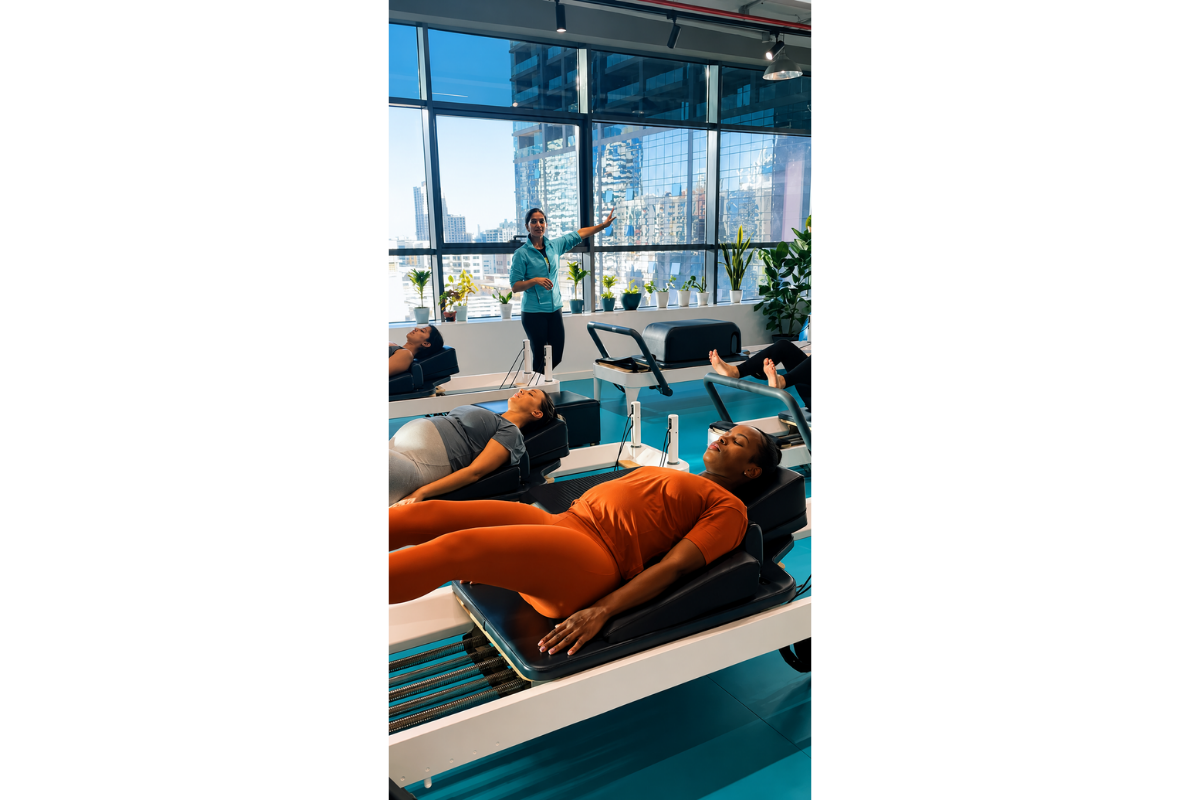
The main shift in the second trimester is moving away from lying flat on your back for long stretches. Full supine positions after around 16 to 20 weeks are commonly reduced in prenatal fitness guidance because of the risk of vena cava compression. That’s when the weight of the uterus presses on a major vein and can affect blood flow.
This doesn’t mean you can never lie down. Instructors usually work with props, an incline, or simply shorter periods in that position, and then move you towards side-lying or seated versions of the same exercise. You’ll also start to notice changes in balance as your bump grows. That’s why classes tend to use the Reformer’s stability more and rely a bit less on pure core control on its own.
Deep twists and full crunch-style movements usually come off the plan around this time. Both can increase strain on the linea alba, the band of connective tissue running down the centre of your abdomen. That’s important because of diastasis recti, a separation of the abdominal muscles that can appear during pregnancy. Instructors with prenatal training replace these with gentler, supported core work so you stay strong without overloading the tissue.
How does Pilates change in the third trimester?
By the third trimester, Pilates is mainly about stability and comfort rather than pushing intensity. Two things drive that shift: relaxin and your changing centre of gravity. Relaxin is a hormone that softens the joints so the body can prepare for birth. Joints that felt stable before can start to feel a bit loose and easier to strain, particularly around the hips and pelvis.
At the same time, your bump pulls your centre of gravity forwards, which alters your balance in almost every position. That’s expected and not, on its own, a sign that anything is wrong.
Prone work, where you’re lying on your front, is usually dropped later in pregnancy for a simple reason: there’s no comfortable way to lie on your stomach with a full-term bump. Good prenatal teaching moves you into supported side-lying or standing versions of those exercises long before it becomes physically impossible.
By the third trimester, instructors are usually keeping an eye on things like:
- Less time spent flat on the back, replaced with inclined or side-lying positions
- Wider stances and more use of props in balance-heavy moves
- Smaller ranges of motion in hip and pelvic work, because joints are more mobile under relaxation
- Shorter, more frequent breaks instead of long static holds
What should you look for in prenatal classes in Dubai?
The single most important thing to check in prenatal classes in Dubai is that the instructor holds proper prenatal certification, not just general Pilates training with a casual “I’m fine with pregnant clients” added on.
Class size matters more during pregnancy than it often does at other times, because the tweaks you need are very individual. An instructor can only spot and respond to that if they can clearly see what’s happening in the room.
At The PAD, we encourage clients to keep their doctor informed throughout pregnancy, especially if something new appears. Cramping, bleeding, dizziness, or unexpected swelling are all signals to stop and check in, not signs to keep going and hope for the best. That’s not really a Pilates-specific rule; it’s just sensible pregnancy care, and any responsible studio will say the same.
The common thread across all three trimesters is simple: Pilates during pregnancy isn’t about doing nothing; it’s about doing versions of the same movements that fit how your body feels right now. If you’d like to know whether our prenatal sessions suit your stage and goals, you’re welcome to contact the team at The PAD, and we’ll help you find the right option.
Frequently Asked Questions
For most people, yes, as long as you don’t have complications and your doctor is happy for you to do moderate exercise. A prenatal-specific class usually makes a better starting point than a general class, because the certified instructor will already plan to build you up steadily instead of assuming you’ve done Pilates before.
No. Most people carry on with more adjustments rather than stopping. The changes mainly affect position and intensity, not whether you move at all, and many clients find that gentle, well-planned sessions actually help with comfort towards the end.
Both can be fine if they’re adapted properly. The Reformer’s stability and adjustable resistance often work well for the balance changes that come with pregnancy, as long as the instructor understands how to adjust things for each trimester.
Tell them as early as you can, ideally before your first class after you find out. That way, adjustments can be part of the plan from session one, instead of being added after a movement turns out not to suit where your body is.
If you notice cramping, bleeding, dizziness, sudden swelling, or any unusual pain, stop and speak to a medical professional rather than finishing the class, whatever stage of pregnancy you’re in.